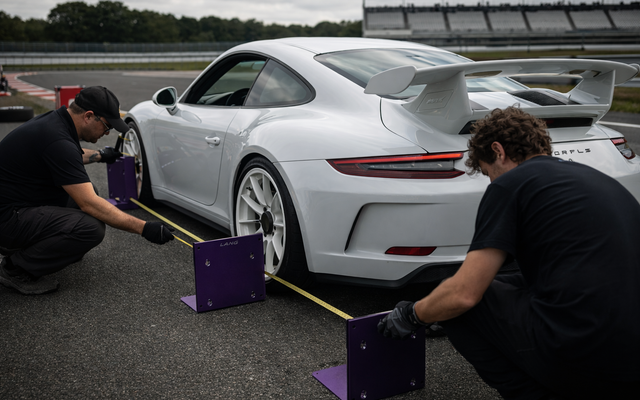
In the demanding arena of today's professional drifting, victory is not merely purely a result of raw engine power or driver courage. Rather, it has become a multifaceted science that demands a scrupulous fusion of selecting a proven car, outfitting it with the most precise drift-spec components, and, most critically, understanding its live behavior on the course through sophisticated vehicle dynamics analysis tools. This comprehensive guide functions as your blueprint from the very first concept of a drift build right through to the last engineering-refined tweaks that transform a strong machine into a consistent champion. We will delve deep into the precise engineering of chassis dynamics adjustment, demonstrating how a advanced suspension tuning tool like GripDial eliminates approximation and provides unmatched clarity into your vehicle's true dynamics.
The foundation of any great competitive sliding vehicle is, without question, the chassis itself. A select group of platforms have achieved iconic standing within the worldwide sliding scene due to their built-in handling characteristics, robust design, and the enormous range of performance parts available. Choosing the right car is the first and most significant choice a builder will make. To illustrate, the BMW's E36 3 Series is commonly accepted as among the finest balanced drift platforms of the modern era. Its almost ideal 50/50 weight distribution, alongside a rear-wheel-drive configuration and bulletproof six-cylinder engines, forms a chassis that is both forgiving for novices and incredibly effective in the control of a professional competitor. The evolution of this concept, the BMW E46, builds upon these qualities with a more sophisticated chassis, increased track for enhanced stability, and even increased turning capability as standard from the factory. Another formidable contender in the top-level scene is the Chevrolet Corvette C6.
This V8-powered track weapon offers a unique array of strengths to the sideways sport, including a light aluminum structure, a rear-mounted drivetrain component that contributes to an ideal balance, and the tremendous thrust of a powerful LS V8 motor. This fusion transforms it into an utter weapon on track, capable of initiating and sustaining extended angles with relatively easy application of throttle. For those looking for remarkable value, the 350Z model Nissan excels as a excellent example. It is delivered from the factory with a stiff platform, a decent factory limited-slip differential, and the smooth VQ35DE motor that offers ample power and torque for mastering and progressing in the sport. Its follow-up, the Nissan 370Z, offers more refinements in structural rigidity, suspension design, and peak motor performance, cementing its place as a favorite selection among professional drivers. Additional historic vehicles that deserve mention encompass the agile unique FC generation RX-7, the ubiquitous Nissan S13, the V8-powered SN95 generation Mustang, the modern BMW E90, and the small yet unbelievably fun and forgiving MX-5 Miata. Each of these cars gives a different array of characteristics, challenges, and possibilities, but they all have in common the basic ingredients required to serve as a capable drift machine.
However, choosing the right chassis is just the first step. To access the true capability of every of these machines, substantial upgrades to the steering and chassis control systems are absolutely mandatory. This is where the realm of performance aftermarket hardware comes into critical view. The one most game-changing modification for a serious drift machine is the installation of a high-performance steering angle kit. These advanced assemblies, such as those manufactured by industry leaders like SLR Speed, are designed to dramatically increase the car's possible turning lock. A factory road car is severely restricted in how far its tires can turn, a engineering trade-off for public road driving. In drifting, however, aggressive countersteering is constantly required to catch and maintain a slide. An angle kit replaces the factory uprights, rod ends, and sometimes control arms with components that allow the front tires to achieve angles in excess of 70 or even 80 °, compared to a average stock setting of around 40 to 50 degrees.
This immensely expanded capability provides the operator with significantly enhanced authority during a angle, enabling it to be much simpler to start a drift, sustain it through a long corner, and change seamlessly from one direction to another. The difference in drivability is truly transformative. Paired with a properly specified steering kit is the equally critical upgrade to the chassis's spring and damper setup. Store-bought or even premium road coilovers are just not engineered for the unique and extreme requirements of drifting. A drift-spec pair of coilovers is of utmost importance. These specific coilovers have specific damping rates and spring stiffness that are optimized for the rapid mass transition that is inherent of sliding. When a pilot starts a drift, the chassis's mass is thrown forcefully to the front of the bend. Correct drift-spec dampers control this movement in a predictable manner, enabling the chassis to stabilize quickly and providing the driver accurate feedback through the controls and seat. They furthermore enable accurate adjustment of stance, rebound and compression firmness, and cross-weight, which are all integral elements of dialing in the vehicle's behavior to a specific venue or piloting approach. Together, a top-tier angle modification system and a correctly specified system of performance suspension units form the absolute physical cornerstone upon which all later optimization is based.
Once the core components is fitted, the following vital step in the project is the precise tuning of the vehicle's wheel angles. This is the domain of chassis dynamics adjustment, a methodology that can appear intimidating to the newcomer but is, in fact, the defining factor to transforming a assembly of capable pieces into a harmonious and controllable whole. The most debated element of suspension geometry for sliding is certainly camber angle. Camber angle is the tilt of the tire in relation to the perfectly straight plane when observed from the front-on of the vehicle. When the top edge of the tire is angled inward, this is referred to as inward tilt. In oversteer driving, inward-leaning wheels on the front axle wheels is widely used and is regarded as critical. The logic is intrinsically related to physics.
When a chassis is cornering at limit sideways angles, the frame rolls to the external of the corner. This lean causes the outside front tire to lose its optimal grip area with the asphalt. By applying inward lean, the tire is pre-tilted to counteract this lean. As the vehicle leans into the corner, the tire becomes more upright on the asphalt, optimizing its traction at the precise point when it is absolutely essential for steering authority. Typically, front adjustments for a serious sliding vehicle vary from approximately -3 degrees to as high as -5 degrees or even more, based on the specifics of the vehicle configuration, compound selection, and operator preference. The rear wheels also utilize inward tilt, but the values are usually more modest and subtler than the front axle. Too much negative camber at the back can make the car extremely tail-happy and difficult to predict on throttle application, as it shrinks the effective grip area of the powered tires during straight-line throttle application. Therefore, rear axle camber settings are commonly in the ballpark of -1 degree to -3 degrees, striking a delicate compromise between providing enough side grip to assist in starting and sustaining the slide while also keeping good traction for exiting the bend. camber angle is just one element of the broader tuning picture, which additionally involves toe angle, caster, and suspension-induced steering correction.
Toe setting refers to the orientation of the tires when viewed from the top. Positive toe means the front edges of the wheels are closer together than the rear edges, while negative toe means the reverse. For sliding, a small amount of front axle toe out is frequently run to improve the turn-in handling response, making the car feel more agile and ready to begin a drift. Rear axle toe setting is usually set to neutral or a incredibly minute amount of positive toe to promote straight-line stability under throttle. self-centering is the frontwards or backwards tilt of the kingpin axis when viewed from the lateral of the chassis. Increased caster angle improves feedback and stability confidence, and it furthermore boosts negative camber effect during cornering, which is extremely beneficial. Tuning these values is a complex interaction where a change to a single parameter can and will affect the remaining parameters. The traditional approach for dialing in a chassis's suspension geometry for competition has historically been a time-consuming affair of trial and error. A driver or team would apply a modification based on intuition, drive the vehicle on track, use the pilot's individual sensation and feedback, and then introduce another tweak. This loop would repeat again and again until the car felt "acceptable" or the allotted practice session ran out. This system is not only exceptionally inefficient in terms of time and costs, but it is additionally inherently imprecise.
Pilot perception is a notoriously inconsistent data source, colored by many variables such as fatigue, varying track surfaces, temperature, and just the focus of the driver on that specific day. What feels "oversteery" on one lap might feel "understeery" on the following pass, leading to conflicting information and ineffective tweaks. This age-old challenge in vehicle dynamics optimization is exactly where state-of-the-art technology has stepped in to completely change the landscape.
The development and application of sophisticated drift telemetry software has ushered in a radically different paradigm for building and optimizing competitive sliding vehicles. This new generation of tools, represented by innovative systems like modern telemetry hardware, function by actively recording the live dynamic performance of the vehicle as it is operated on the course. In contrast to relying on driver impression, these devices gather measurable metrics on key parameters such as shock absorber movement, corner velocities, G-force loading, lock position, and throttle and brake input. This raw telemetry is then interpreted by advanced algorithms that can visualize and interpret the information in a clear manner. For the first time, drivers and builders can observe precisely what the car is performing at every millisecond of a drift. This capability revolutionizes the complete chassis setup workflow. Consider the specific goal of dialing in the front axle camber for a specific vehicle. Rather than making a adjustment from -3 degrees to -3.5 degrees and then driving many passes to try and "perceive" a difference, a vehicle dynamics tool can provide immediate and irrefutable data. The application can indicate graphically how the tire's grip is performing during the key moments of a drift: the initial flick, holding the angle, and switch. It can reveal if the existing angle is allowing the outside front tire to achieve optimal loading or if the compound is overloaded on its outside edge.
The tool can then make empirical advice for adjustment. Perhaps the telemetry shows that the outside front tire is even overworking its outer shoulder at -3.5 degrees of camber, implying that an increase to angle, say -4 degrees, might be beneficial. On the other hand, the data might indicate that the tread is failing to coming up to optimal operating temp or that the inside shoulder is wearing unevenly, which could point to that there is overly aggressive angle and a slight decrease back to -3.2 degrees would be more efficient. This degree of accuracy and useful intelligence was completely unattainable in the era of solely car suspension tuning seat-of-the-pants setup.
The impact of using a advanced drift telemetry system goes much further than merely setting camber. It becomes an invaluable damper adjustment manual that is specific to your exact car. When fine-tuning the rebound and compression settings on your coilovers, rather than relying on vague tips or replicating another team's setup, you can employ the software to observe how the chassis is performing in response to your tweaks. The software can display the wheel movement path over a section of track, showing if the shocks are handling the body movement optimally or if they are causing the chassis to bounce uncontrollably after a direction change. It can aid in identifying problems like excessive compression or excessive extension, enabling you to make data-backed adjustments to helper springs, damping rates, or ride height. This methodology extends equally to the detailed task of corner balancing. Beyond camber, the system can provide insight into how modifications to toe and caster angle are affecting the vehicle's stability during specific parts of a slide. For example, it can allow you to find the optimal amount of front toe-out for your specific steering rack configuration and competition style by measuring the quickness of turn-in response and the predictability of the chassis at full lock. This makes the software an extremely powerful vehicle dynamics manual that is constantly informed by the live dynamics of your specific chassis on the tarmac. It elevates the complete project from a dark art into a repeatable optimization process.
Furthermore, the value of a system like GripDial is not limited to professional tuners with large budgets. For the grassroots driver, it acts as an powerful educational tool. It practically gives the builder with the insight vehicle dynamics tool of a expert suspension specialist without requiring the corresponding cost. It speeds up the development time by giving clear answers to questions that would normally take years of trial and error to understand. A tuner can see how their specific vehicle reacts to different inputs, developing a deeper understanding of suspension theory in the endeavor. It additionally makes accessible advanced chassis dynamics concepts, enabling anyone with the desire to refine their vehicle to accomplish it in a structured and successful fashion. This is especially significant in a sport like oversteer competition, where tuning knowledge has in the past been a tightly held commodity among top crews. In the modern era, that capability can be in the toolkit of any motivated enthusiast.
In summary, the journey to constructing and tuning the perfect competitive sliding vehicle is a comprehensive endeavor that smoothly integrates classic engineering principles with 21st-century digital tools. It commences with the strategic selection of a capable chassis, then built upon the installation of non-negotiable performance hardware like high-performance drift angle kits and expertly valved competition suspension units. The build then progresses into the precision realm of alignment optimization, where values like negative camber, toe setting, and caster angle are precisely configured to complement the chassis's new capabilities and the driver's individual technique. The final step, and what genuinely distinguishes the contemporary methodology from the old ways, is the use of a sophisticated vehicle dynamics tool. This system removes the approximation and waste of only seat-of-the-pants adjustment by providing objective, real-time data on how the vehicle is actually functioning. It functions as an indispensable engineering partner, a definitive coilover setup manual, and a comprehensive performance analyzer. In unison, this integrated approach leads to that each and every aspect of the drift machine—from the choice of the platform to the final click on the damper—is optimized for peak performance on the track. It signifies the full progression of the discipline of sliding, connecting raw pilot car alignment tuning talent with precise vehicle setup to build the most dominant machines attainable.